August 11, 2026
What Is an Appliance API? A Guide for Appliance Retailers

Chris Johnson
CEO

Every appliance retailer depends on product information that they don’t create themselves. The challenge isn’t getting that information once; it’s keeping it accurate as manufacturers continue to update it. Prices, specifications, dimensions, images, and product availability all originate with the manufacturer, but they must still appear accurately on the retailer’s website.
The challenge is that manufacturer data never stands still. Products are updated, new models are introduced, specifications are corrected, and older products are discontinued throughout the year. Keeping up with those changes has traditionally meant downloading spreadsheets, checking dealer portals, and manually updating product listings.
An appliance API offers a different approach. Instead of collecting product information brand by brand, retailers can retrieve structured manufacturer data through a single connection.
Understanding what an appliance API is, how it works, and why it exists helps explain why more retailers are moving away from manual catalog maintenance.
What Is an Appliance API and Why Does It Matter?
API stands for Application Programming Interface, but retailers don’t need to understand the technical terminology to understand what it does.
An appliance API is a way for software systems to exchange appliance product information automatically. In simple terms, it allows one system to request product information from another without manual copying and pasting.
Think of an appliance API as a bridge between manufacturer product data and the systems retailers use every day. It allows websites, Point of Sale (POS) systems, PIM platforms, and other business applications to automatically retrieve structured product information rather than relying on manual data collection.
Because product information changes continuously, retailers need a reliable way to retrieve those updates. Product information isn’t static. It changes throughout a product’s lifecycle, creating an ongoing challenge for retailers to keep their catalogs accurate. Manufacturers regularly update product specifications, pricing, images, documentation, and lifecycle information.
Without an API, retailers often need to collect those updates from spreadsheets, PDFs, dealer portals, or manufacturer websites. An appliance API simplifies this process by making current product information available via a standardized interface.
How that information is used depends on each retailer’s workflow. Some businesses review product updates before publishing them, while others incorporate API data into automated catalog processes. The API provides the product information, while retailers decide how and when it moves through their own systems.
What Information Does an Appliance API Provide?
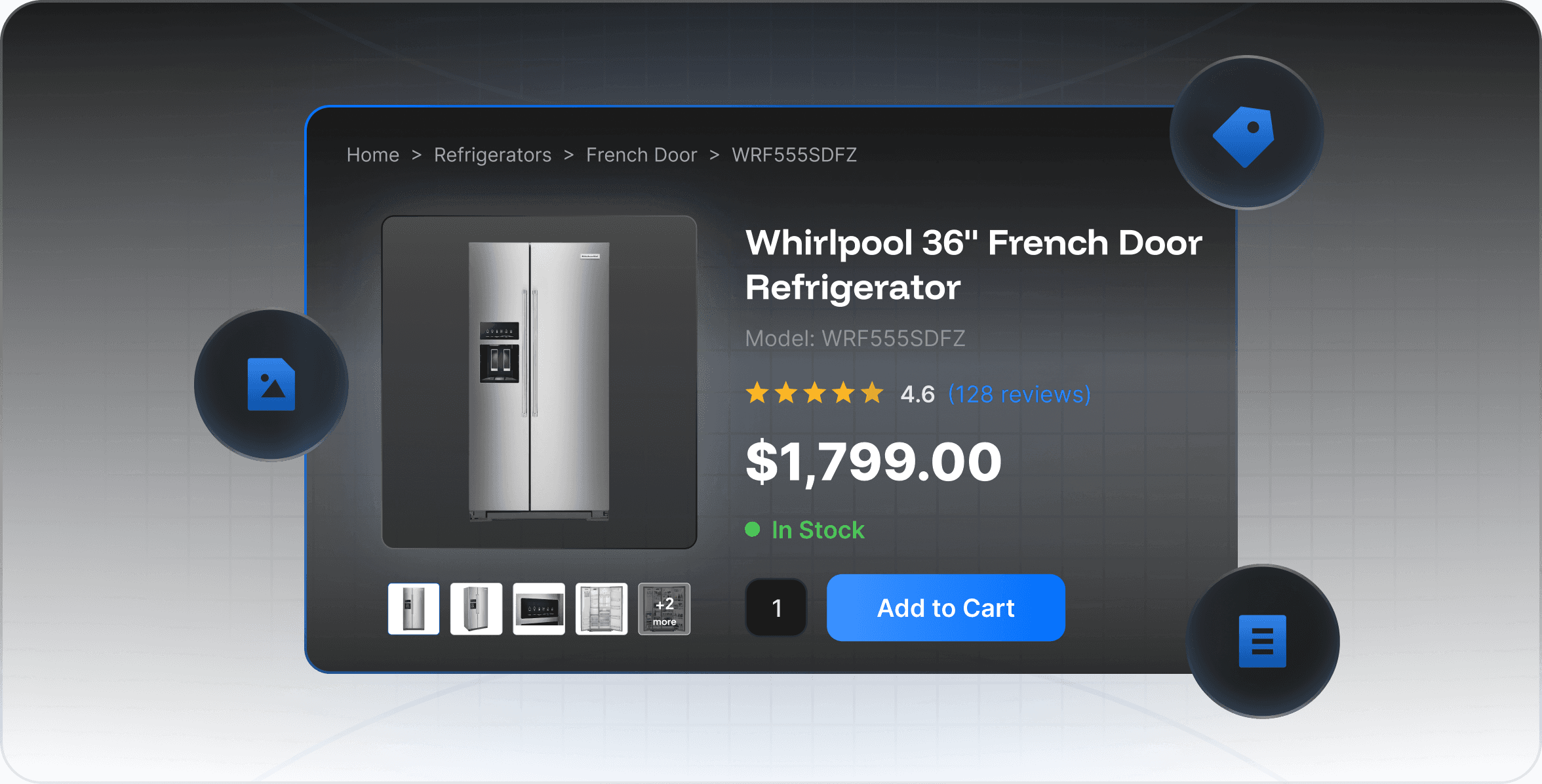
The information available through an appliance API depends on the provider and manufacturer authorizations, but it typically includes much more than product names and prices. Retailers may be able to retrieve:
Product Specifications
Technical details such as dimensions, fuel type, voltage, capacity, energy certifications, and installation requirements.Images and Marketing Assets
High-resolution product images, lifestyle photos, logos, and other marketing materials.Product Documents
Specification sheets, installation guides, user manuals, warranty information, and other supporting documents.Product Lifecycle Information
Product status, including newly released, active, discontinued, or end-of-life models.Pricing and Promotions
Manufacturer pricing, rebates, and promotional information are authorized.
Providing that information in a structured format makes it easier for retailers to maintain consistent product information across websites, POS systems, and other sales channels.
In practice, a “structured format” means every product attribute is stored consistently in its own dedicated field. Rather than combining information into long text descriptions, dimensions, electrical requirements, fuel types, and other specifications are organized into standardized attributes.
Measurements can also be standardized into consistent units, such as inches or centimeters, or provided in both formats, making the data easier for business systems to process, search, filter, and display consistently.
Why Retailers Use Product Data APIs
Retailers use product data APIs because collecting and maintaining manufacturer product information becomes increasingly difficult as product catalogs grow.
Every manufacturer organizes product information differently. Specifications, dimensions, pricing, images, product documents, and lifecycle updates may all be published in different formats, with different naming conventions and schedules. Keeping product information accurate across hundreds or thousands of products quickly becomes difficult to manage manually.
Product data APIs help simplify that work by providing retailers with a consistent way to access manufacturer product information. A single API connection gives retailers access to structured product data, while allowing them to decide how that information is reviewed, approved, and used within their own workflow.
Not every product data API supports the specialized product information appliances retailers need. Appliances include technical product information that directly affects purchasing, installation, and after-sales support.
Skulytics is built specifically for appliance retailers. Through a single API, retailers can access structured product data from hundreds of manufacturers while remaining in control of how that information is reviewed, approved, and published.
To see how that works in practice, let’s follow a single product update as it moves through the Skulytics API.
How Product Data Moves Through Skulytics API
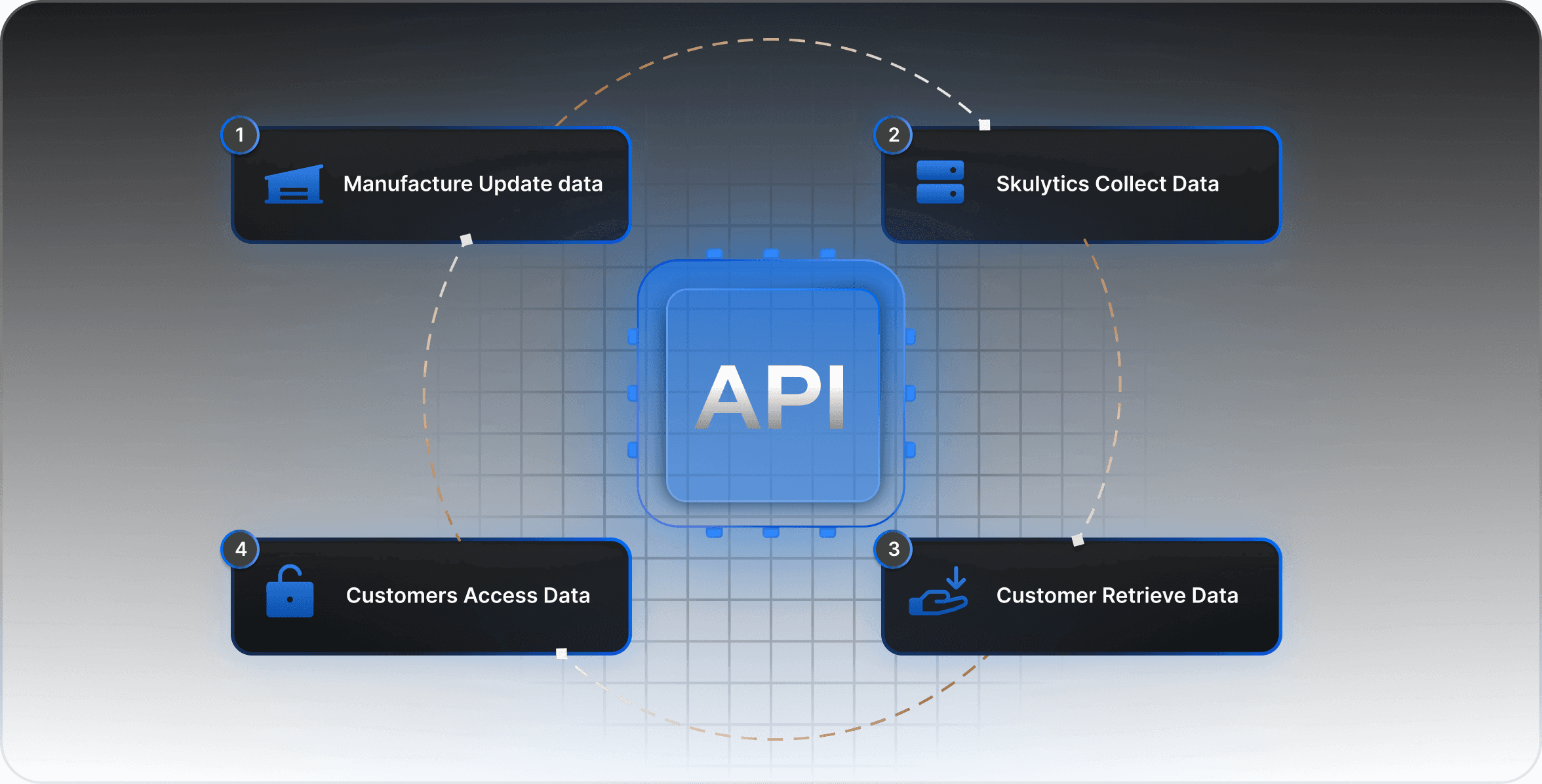
The easiest way to understand how the Skulytics API works is to follow a single product update from the moment a manufacturer changes it to the moment customers see the updated information.
Imagine a manufacturer updates the advertised price of a wall oven. The same process also applies to revised dimensions, installation guides, product images, specifications, or even a discontinued model.
Step 1: Manufacturers Update Their Product Information
Everything starts with the manufacturer. Product information changes regularly throughout a product’s lifecycle. A manufacturer may update pricing, revise specifications, upload new marketing assets, publish updated installation documentation, or discontinue a product altogether.
At this stage, the updated information exists only in the manufacturer’s systems. Retailers won’t automatically see those changes unless they have a way to retrieve them.
Step 2: Skulytics Collects and Standardizes the Product Data
Once manufacturers provide updated product information, Skulytics collects and standardizes it from supported manufacturers before making it available via the API, subject to manufacturer authorizations where applicable.
This standardization is important because manufacturers often describe similar information in different ways. One brand may label refrigerator capacity as “Cu. Ft.,” while another simply uses “Capacity.” Dimensions may use different naming conventions or units of measurement. Skulytics organizes those attributes into a consistent structure, making product data easier to search, compare, filter, and display across retailer systems.
The API makes structured product data available to retailers. It doesn’t automatically publish changes or decide how the information should be used.
Step 3: Retailers Retrieve the Product Data
Retailers decide how product data fits into their own workflow. Some businesses review updates before publishing them on their website or in their POS system. Others automate selected updates while requiring manual approval for pricing or lifecycle changes. The API provides the product information, while retailers decide how and when it moves through their own systems.
Step 4: Customers Access Updated Product Information
Once retailers publish the updated product data, customers can browse product pages with more up-to-date product information. Dimensions, specifications, installation requirements, product documents, images, and other details are more likely to reflect the latest information available through the retailer’s catalog management process.
What Changes When You Implement an Appliance API
An appliance API doesn’t change how retailers run their business. It changes how product information moves from manufacturers into their systems. With a more efficient way to access product data, retailers can spend less time maintaining catalogs and provide customers with more accurate product information.
1. Spend Less Time Maintaining Product Data
Manufacturers regularly update specifications, pricing, images, and documentation. An appliance API provides a more efficient way to retrieve those updates, reducing the time spent collecting product information from multiple sources.
2. Keep Product Information Consistent Across Sales Channels
Structured product data makes it easier to keep websites, POS systems, and other connected applications aligned with the same product information, reducing inconsistencies across customer touchpoints.
3. Respond to Product Changes More Efficiently
Manufacturers regularly introduce new products, revise specifications, update documentation, and discontinue older models. An appliance API gives retailers a more efficient way to retrieve those changes, helping them publish new products sooner and keep existing product information up to date.
4. Support Better Search and Filtering
Structured product data also enables advanced product filtering. Customers can compare appliances by dimensions, fuel type, capacity, voltage, finish, and other technical specifications, making it easier to narrow down products that meet their requirements.
5. Improve the Customer Experience
Customers rely on accurate product information to compare appliances, verify installation requirements, and choose the right model. Keeping product information current and consistent helps shoppers make more informed purchasing decisions while reducing confusion throughout the buying process.
6. Help Reduce Preventable Returns
Returns caused by inaccurate dimensions, outdated specifications, or incomplete product information can often be avoided before a purchase is made. Providing customers with up-to-date product data helps retailers reduce preventable returns and improve overall order accuracy.
Ultimately, the value of an appliance API isn’t measured by the API itself. It’s measured by what retailers can accomplish with more accurate and accessible product information. From reducing manual work to improving the customer experience, better product data supports better business decisions.
If you’re looking for a more efficient way to access structured appliance product data, Skulytics provides access to product information from hundreds of manufacturers through a single API. Explore the Skulytics API, view pricing, or contact our team to learn how it can support your business.
