August 25, 2026
Why Multi-Brand Furniture Retailers Need a Furniture API

Chris Johnson
CEO

Multi-brand furniture retailers manage product information coming from every manufacturer they carry. One brand may provide product updates through spreadsheets, while another uses dealer portals or PDF documents. Product names, dimensions, fabrics, finishes, collections, images, and pricing can also be organized differently from one manufacturer to another.
When furniture retailers add more brands, they aren't simply adding more products. They're adding more sources of product data that need to be collected, organized, and updated. Furniture makes that challenge even more complicated because a single product can have multiple configurations. One sofa may be available in several widths, fabrics, finishes, and other options, each with its own product information.
Across multiple manufacturers and thousands of products, maintaining those details manually can quickly become difficult to scale. This is where a furniture Application Programming Interface (API) can help. A furniture API gives retailers a structured way to access product data from manufacturers without having to build a separate manual data process for each brand.
But what exactly does a furniture API provide, how does it work, and when does a multi-brand retailer actually need one?
What Is a Furniture API and Why Does It Matter?
Furniture retailers don't need to understand the technical side to understand what a furniture API does. API stands for Application Programming Interface, which is essentially a way for different software systems to communicate with each other.
In furniture retail, that communication can be used to access product information. A furniture API gives a retailer's system a way to request product data from another source without having to manually collect and enter that information every time.
For furniture retailers, that data can include product names, SKUs, descriptions, dimensions, specifications, collections, fabrics, finishes, images, documents, pricing, and other information provided by the data source.
Each manufacturer may organize and provide its product information differently. A furniture API can give retailers a consistent way to access that information through one connection, making it easier for their own systems to work with product data from different manufacturers.
The API itself does not decide where the data should go or automatically publish every update to a retailer's website. Retailers determine how the data fits into their own workflow. For example, product information retrieved through an API could be reviewed before publication or incorporated into workflows that support an eCommerce site, Point of Sale (POS) system, Enterprise Resource Planning (ERP) platform, or other business applications.
That distinction is important: the furniture API provides access to structured product data, while the retailer controls how that data is used.
How a Furniture API Simplifies Multi-Brand Product Data
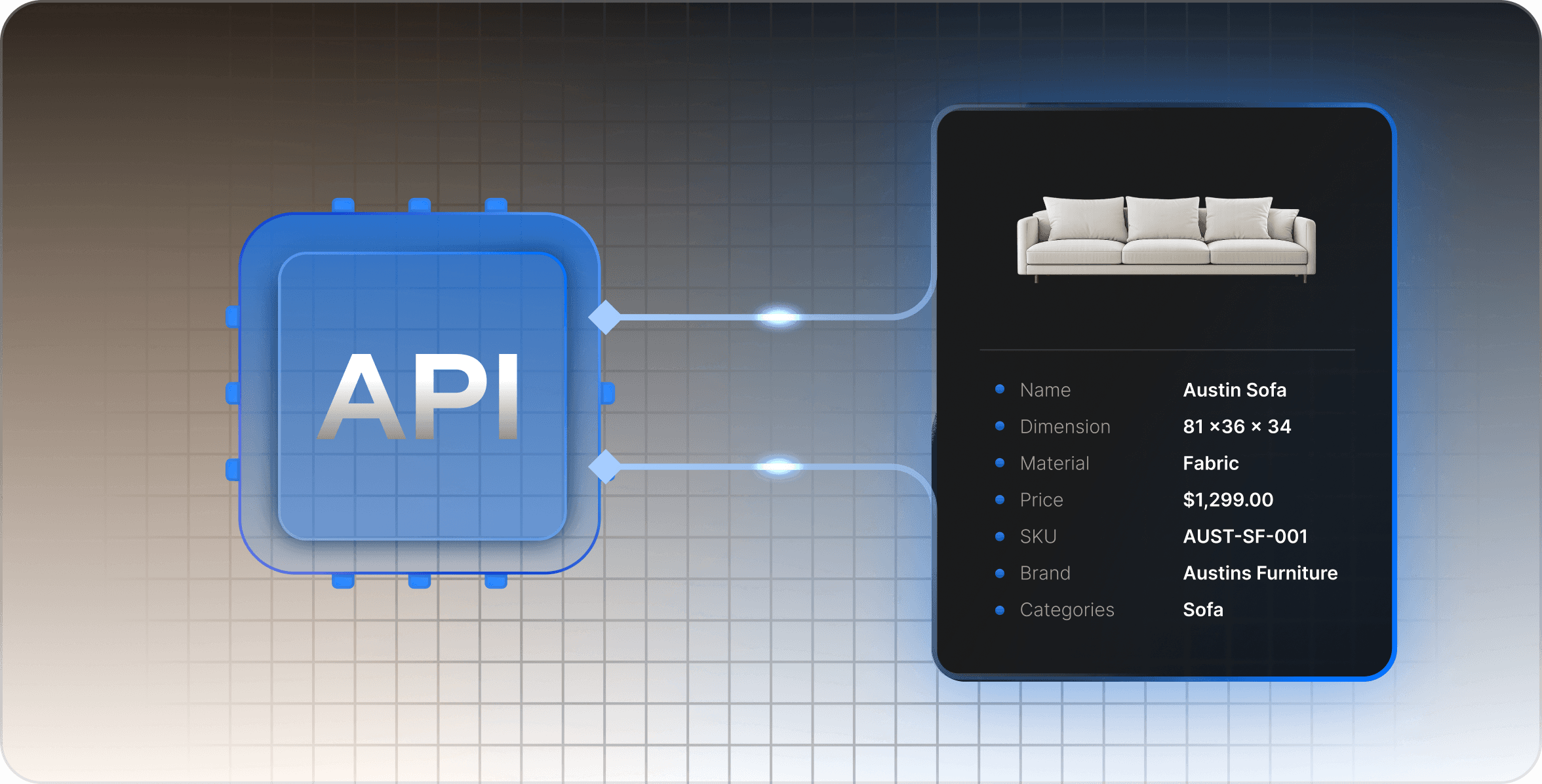
The value of a furniture API becomes clearer as the number of brands and products grows. By providing structured product information through a consistent connection, an API can simplify several parts of multi-brand catalog management. Here are four areas where it can make a difference.
Standardize Product Information Across Brands
Different manufacturers may use different terminology, units, and formats for the same product attributes. Dimensions, materials, finishes, and other specifications can therefore look different from one brand to another.
A furniture API can normalize that information into a consistent structure. For example, dimensions can use dedicated width, height, and depth fields with consistent units, while fabrics, finishes, and other attributes follow standardized fields across brands.
Manage Furniture Variants and Configurations More Consistently
A single furniture model can come in multiple sizes, fabrics, finishes, and configurations. As those combinations grow across multiple brands, keeping every variation organized becomes increasingly difficult.
A furniture API can provide those options as structured product attributes, making it easier to connect different configurations to the right product and use them for product pages, filtering, and comparison.
Keep Product Changes Easier to Track
Manufacturers regularly introduce new products, update pricing or specifications, add new finishes, and discontinue existing models or configurations. Tracking those changes across multiple brands can require retailers to check several different sources.
A furniture API provides retailers with a consistent way to retrieve up-to-date product information. The API makes those changes available, while the retailer decides whether to review, approve, or incorporate updates into an automated workflow.
Use the Same Product Data Across Multiple Retail Systems
The same furniture product data may be needed across an eCommerce website, POS system, ERP platform, and other business applications.
A furniture API provides a consistent source of structured data that retailers can integrate with those systems. Each retailer still controls which data is retrieved and how it moves through their own workflow.
When Should Furniture Retailers Consider a Furniture API?
Not every furniture retailer needs an API. For stores carrying only a small number of brands or products, manual catalog management may still be manageable. The need becomes clearer as the catalog grows and maintaining product information starts taking more time and resources.
Furniture retailers may need to consider a furniture API when:
They’re adding more furniture brands
Each manufacturer introduces another catalog, data format, and update process. As more brands are added, keeping those different sources organized becomes increasingly difficult.
Their team spends too much time maintaining product data
Importing files, updating specifications, collecting images, and correcting listings can become recurring work as the catalog grows.
Product information is inconsistent across brands
Different naming conventions, units, and product structures can make it harder to maintain consistent product pages, search, and filtering.
Product data needs to support multiple systems
Websites, POS systems, ERP platforms, and internal applications may all depend on the same product information.
Once those challenges start appearing, the next question is whether a furniture API can support the specific products, brands, and workflows your business needs.
When evaluating an API, retailers should consider manufacturer coverage, available product attributes, furniture variants and configurations, data normalization, images and media, update frequency, manufacturer authorization, API documentation, and scalability as more brands and products are added.
Manage Furniture Data with Skulytics
A furniture API becomes especially useful when retailers need to manage product information across a growing number of manufacturers. This is the type of multi-brand product data challenge Skulytics is designed to support.
Skulytics is a product data platform that provides retailers with access to structured furniture product data from multiple manufacturers via a single API. Instead of building a separate product data process for each brand, retailers can use a single connection to access information such as specifications, dimensions, fabrics, finishes, images, and other product attributes.
This gives retailers a product data foundation that can grow alongside their catalog. As new brands and products are added, teams can spend less time collecting and organizing manufacturer data manually while remaining in control of how that information is used across their own systems.
Ready to simplify multi-brand furniture product data? Explore Skulytics to learn more about the Product Data API. Check Skulytics pricing to find the right plan or contact the team to discuss your product data needs.
