July 14, 2026
Managing Discontinued Furniture Products Without Manual Updates

Chris Johnson
CEO

Every outdated furniture product listing has the potential to become a customer service issue.
Imagine a customer orders a sleeper sofa from your website after comparing several options online. The order is confirmed, but during processing, your team discovers that the manufacturer discontinued the model months earlier. The retailer’s remaining inventory had already been depleted, yet the product listing still showed the item as available because the latest product update never reached the catalog.
Situations like this are rarely caused by inventory alone. More often, they’re the result of product data that no longer reflects the latest manufacturer updates.
Furniture retailers frequently encounter situations like this because manufacturers continually update product availability, specifications, and product lifecycles. Retailers may continue selling existing inventory, but they still need accurate product information so that inventory, availability, and product status always reflect the latest manufacturer updates.
Maintaining accurate, up-to-date product data helps prevent outdated information from reaching customers in the first place. With the right product data management process, keeping product catalogs up to date becomes simpler, faster, and far less time-consuming.
Why Do Discontinued Furniture Products Stay Online?
Discontinued furniture products often remain visible online because manufacturer updates don’t always reach product catalogs immediately. Retailers relying on manual catalog maintenance must continuously collect, review, and apply updates from multiple manufacturers. Keeping every product listing current becomes increasingly difficult as updates from multiple manufacturers continue to arrive throughout the year.
Product updates often arrive through spreadsheets, emails, PDFs, or manufacturer portals, requiring someone to review the information and manually update the catalog. When updates aren’t processed promptly, product listings can quickly fall out of sync with the latest manufacturer information.
Managing hundreds or even thousands of product updates manually isn’t just time-consuming. Product data issues often remain hidden until a customer order reveals that the catalog no longer reflects the retailer’s current inventory or product availability.
The Burden of Manual Product Updates
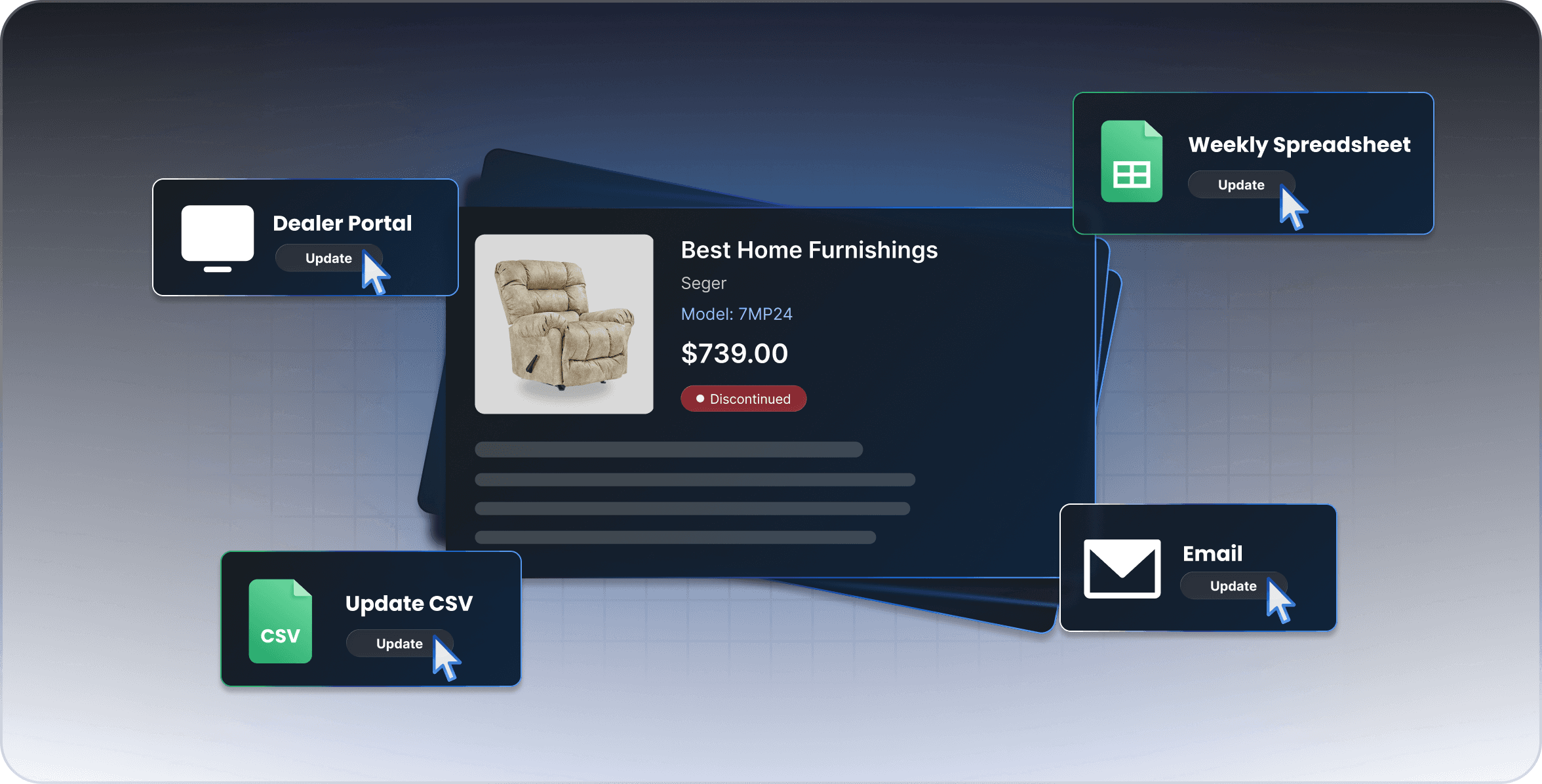
A furniture retailer rarely works with a single manufacturer. A retailer may carry products from Ashley Furniture, Flexsteel, Ethan Allen, La-Z-Boy, Liberty Furniture, and dozens of other brands, each sharing product updates in different ways. One manufacturer sends weekly spreadsheets, another publishes updates through a dealer portal, while others simply notify retailers by email.
Before a single product listing can be updated, someone has to collect information from every source, compare it against existing product records, identify what has changed, and manually update the catalog.
For example, a discontinued recliner may require an update to reflect its current availability and lifecycle status. The same changes may also need to be reflected on the retailer’s website, marketplace listings, and POS system.
Those updates don’t arrive all at once. Manufacturers release product changes throughout the year, meaning retailers must continuously monitor, review, and update their catalogs to keep product information current.
What makes manual catalog maintenance challenging isn’t the complexity of a single update. It’s repeating the same process across hundreds of products, dozens of manufacturers, and multiple sales channels. Product catalog maintenance quickly becomes a continuous operational responsibility rather than an occasional task.
Teams often prioritize customer inquiries, showroom sales, deliveries, merchandising, and other daily responsibilities first, making product updates easy to postpone. Over time, postponed updates accumulate. Information about a discontinued product remains unchanged for another week. Product availability, replacement models, or other important updates may also remain outdated, increasing the risk of customer confusion.
Eventually, the retailer doesn’t discover the outdated product information during a routine catalog review. They discover it after a customer places an order that can no longer be fulfilled.
How Discontinued Products Create Bigger Problems
Consider what happens after a customer orders a discontinued product. A customer places an order for a dining table that’s still available on the retailer’s website. The manufacturer had discontinued the model months earlier, and the retailer had already sold the remaining inventory. Because the product information was never updated, customers could still place orders for a product that was no longer available.
What looked like a simple product listing issue quickly becomes a much larger operational problem. The sales team now has to explain why the order can’t be fulfilled and recommend an alternative product.
However, offering a replacement doesn’t always solve the problem. Unlike everyday purchases, furniture buying decisions are often based on specific preferences such as style, color, dimensions, or material.
A customer who specifically chose a walnut dining table for its finish, dimensions, or design may not be interested in a similar oak model, even if it’s readily available. Some customers simply cancel the order and continue their search with another retailer. The business loses not only the immediate sale but also the opportunity to build a long-term customer relationship.
The work doesn’t end with a canceled order. Customer service contacts the customer to explain the situation, apologize, and discuss available options. Finance processes the refund, while inventory and merchandising teams verify whether similar discontinued products remain in the catalog. Marketing may also need to review ongoing promotions or advertisements to ensure they no longer feature the discontinued product. Meanwhile, the customer is left waiting for a solution while confidence in the retailer begins to erode.
What started as one outdated product listing has now become a business-wide operational issue. Instead of helping customers, closing new sales, or growing the business, multiple teams spend valuable time resolving a problem that accurate product data could have prevented.
Automate Furniture Product Catalog Updates with Skulytics

By now, it’s clear that keeping furniture product catalogs accurate isn’t simply about responding to discontinued products. It requires a product data management process that keeps retailer product information aligned with ongoing manufacturer updates.
Skulytics helps retailers simplify that process by collecting product data from multiple manufacturers, standardizing product records, and maintaining an extensive product database through a single API. As manufacturer product information changes, Skulytics helps collect, standardize, and maintain those updates in a centralized product database.
Retailers can keep product catalogs up to date with less manual effort. Teams spend less time maintaining product data and more time supporting customers, processing orders, and growing the business.
Skulytics supports more than 300 authorized appliance brands and provides product data for furniture, mattresses, and other retail categories. Retailers can manage product details across different product categories without relying on separate data sources.
Explore Skulytics’ furniture product data solutions, browse pricing plans, or speak with the team to find the right fit for your business.
