August 18, 2026
Inside Reusely’s Safe Automation: Reducing Catalog Maintenance by 85% with Skulytics

Chris Johnson
CEO

Reusely is a trade-in and buyback platform that helps businesses across multiple product categories. This platform connects pricing, logistics, item tracking, payouts, and other operational workflows in one system.
Originally, Reusely focused on supporting electronics buyback and trade-in businesses, such as smartphones, laptops, and other gadgets. As it grew, so did the range of products it could support. Reusely has since expanded into other categories, such as fishing tackle and golf clubs, and plans to continue supporting more product categories over time.
The expansion created a new data challenge for Reusely. Every additional category and brand brings more products, specifications, images, and other data that need to be identified, organized, and maintained. Building and continuously maintaining that growing catalog internally would require significant development resources and time.
Skulytics became part of Reusely's product data infrastructure, providing structured product and category data as its catalog expanded. By connecting to Skulytics, Reusely could rely on an external source of product data without building and maintaining a constantly changing catalog database entirely on its own.
Building a Self-Maintaining Gadget Catalog
Keeping track of the same device across different data sources proved challenging for Reusely. A product name might look slightly different across databases. Categories may not always be organized the same way. Without a reliable way to link those records, the team had to spend time matching devices, cleaning up catalog data, and ensuring everything pointed to the right product.
Skulytics helped solve that problem with a consistent matching ID. The matching ID gives each product a unique identifier that both systems can use to recognize it. For example, even if the same smartphone has a slightly different name or product information in each system, the matching ID tells Reusely that they are still the same device. When the product data changes, Reusely knows exactly which device or category the update belongs to, without the team having to match it manually again.
"Once a device or category exists in Skulytics, it flows into our system automatically. No one on our team is manually entering model names, categories, or specs anymore."
Winapamungkas Rino, Tech Lead at Reusely.
Rino said the consistent matching ID across every record is one of the most valuable parts of the Skulytics integration.
“It means we no longer have to build and maintain our own massive, constantly-changing device catalog database.” – Winapamungkas Rino, Tech Lead at Reusely.
Safer Catalog Automation Without Sacrificing Control
It took over roughly seven months for Reusely to connect its catalog with Skulytics. The integration evolved through two phases as the engineering team learned how to balance automation with control over the data reaching customers.
Phase 1: Building a Direct Sync
The first version focused on efficiently moving product data. Reusely built a direct sync pipeline that pulled data from Skulytics while also receiving real-time updates through webhooks. Those updates were then written directly into Reusely's production catalog tables.
The approach automated the flow of product data, but it also meant that incoming changes could reach the live catalog immediately. As the team worked on the integration, they recognized the risk. If incorrect or unexpected data entered the pipeline, it could affect the production catalog before the team had a chance to review it.
Phase 2: Adding a Safety Layer
Reusely recognized the risk of sending external data directly into production as the team working on the first version of the integration.
“After running Phase 1, we realized writing external data directly into production carried real risk. So we re-architected it: incoming data now lands in a staging table first, gets reviewed, and only then gets promoted to the live tables,” Rino said.
Reusely responded by reworking the integration around a staging and review process. Product data from Skulytics now lands in a staging table first, where the team can review it before promoting it to the live catalog.
“We also added a dedicated processing queue with real-time Slack notifications, so the team can monitor large sync batches as they happen instead of finding out about a problem after the fact,” said Rino.
The result is automation with an added layer of control. Skulytics provides the product data and update mechanisms, while Reusely determines how that data is reviewed, processed, and ultimately moved into its live catalog.
What Changed in Reusely’s Workflow?
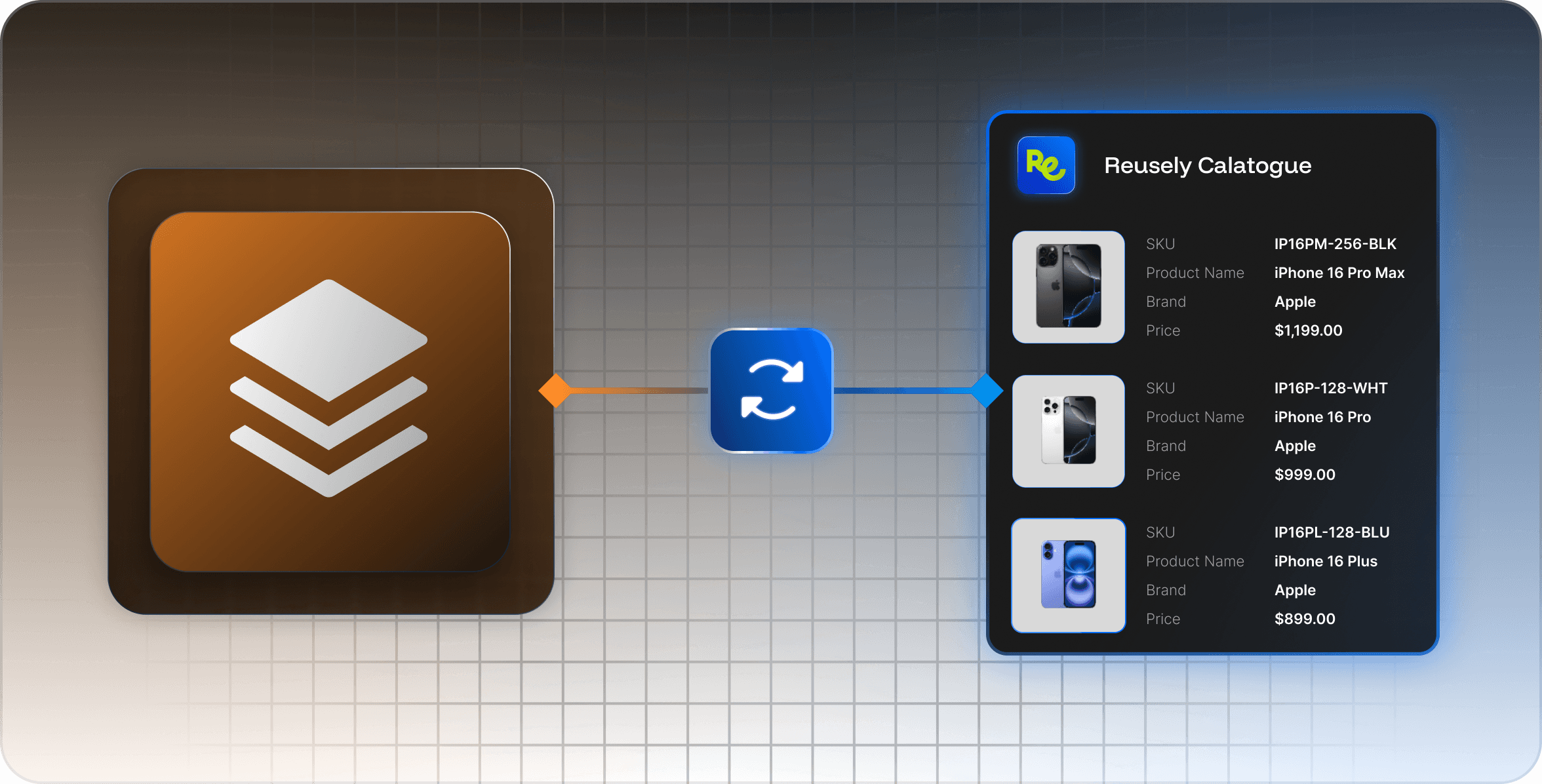
The integration with Skulytics changed Reusely’s workflow. The result extended beyond keeping Reusely's catalog up to date. Tasks that previously required separate manual work became part of a connected workflow.
“Without Skulytics, we'd likely need a dedicated team just to keep the catalog accurate, and that would slow down every feature that depends on clean catalog data.”
Winapamungkas Rino, Tech Lead at Reusely.
Up to 85% Less Catalog Maintenance
Rino explained that, before integrating with Skulytics, the catalog updates, search reindexing, and image syncing were separate processes that could easily drift out of sync. Now, search reindexing and asset syncing run automatically as part of the same pipeline. Thus, the catalog, search results, and product images always stay consistent.
Reusely’s developers estimate there is roughly 80–85% time saved on product data maintenance after integration with Skulytics.
“We estimate around an 80–85% reduction in manual catalog maintenance work. Matching devices and categories, and keeping them current, used to be a recurring manual task, it's now automatic.” – Winapamungkas Rino, Tech Lead at Reusely.
Up to 90% Less Manual Effort
Updating the product catalog was only one part of the work in Reusely. Search reindexing and product image management were separate processes, creating additional manual steps whenever catalog information changed. Now, those processes are connected through the same integration workflow.
“Across the full pipeline, device or category matching, search reindexing, and product image management, we estimate 85–90% less manual effort.” – Winapamungkas Rino, Tech Lead at Reusely.
Faster Feature Delivery
Less manual work enables Reusely to deliver features 2x faster. “Catalog-dependent features now ship roughly 2x faster, since the data arrives clean and structured instead of needing cleanup first,” Rino said.
Building features on top of the Skulytics-synced catalog has also cut Reusely’s development time by roughly 30–40% for anything that touches device or category data.
Up to 80% Efficiency Gain
Skulytics has made Reusly’s work easier and faster. Rino estimates a roughly 70–80% efficiency gain in catalog-related work.
“Combining the reduced manual work with the automated search and asset syncing, we'd estimate a 70–80% efficiency gain for the team on catalog-related work. Time now goes toward building new features instead.” – Winapamungkas Rino, Tech Lead at Reusely.
From Catalog Maintenance to Peace of Mind
Rino mentioned there are three most impactful changes in Reusely’s workflow after integrating their catalog with Skulytics. Those big changes are a self-maintaining catalog, a safe two-way sync, and automated search indexing and asset management.
“Skulytics pushes updates to us in real time via webhook, and we also pull data on a schedule as a reconciliation safety net. Whenever the catalog changes, our search index rebuilds itself, and product images sync through the same integration.” – Winapamungkas Rino, Tech Lead at Reusely.
Rino said the biggest benefit of using Skulytics services has been peace of mind. The team no longer worries about our device catalog going stale or becoming inconsistent.
“The biggest benefit has been peace of mind. Skulytics gives us a single source of truth we can trust, plus a safe way to automate without sacrificing quality control, which frees our team to focus on building the best possible experience for customers selling their devices.”
Winapamungkas Rino, Tech Lead at Reusely.
Reusely's experience shows that catalog automation does not have to mean giving up control. Skulytics provides the structured product data and integration capabilities, while businesses can determine how that data moves through their own systems and what checks happen before it reaches customers.
For businesses facing similar challenges, Skulytics provides structured product data across multiple categories through a single Application Programming Interface (API). Explore Skulytics to see how the platform can help your team spend less time building and maintaining product data infrastructure, view pricing to find the right plan, or contact Skulytics team to discuss how it can support your existing workflow.
